
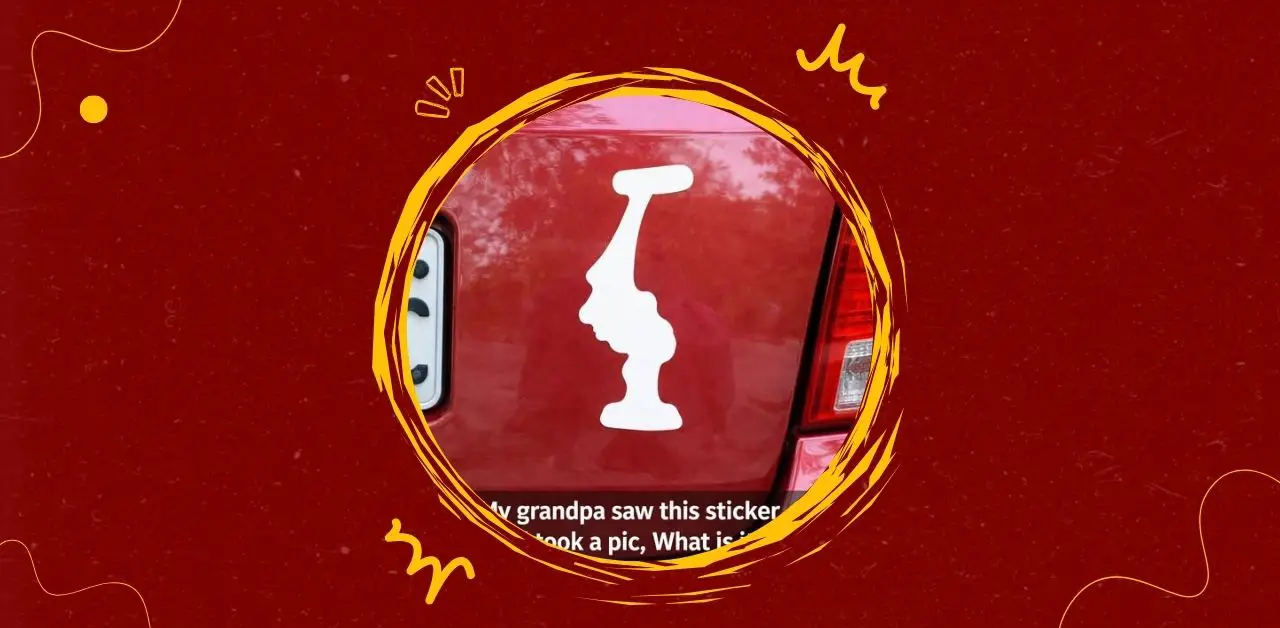
Visual illusions have always intrigued both scientists and everyday observers because they reveal how our brains interpret — and sometimes misinterpret — the world around us. The sticker your grandfather photographed is a classic example of one of the most famous optical illusions in psychology: the Rubin vase.
What Is the Rubin Vase?
The Rubin vase, named after Danish psychologist Edgar Rubin who introduced it in 1915, is a figure-ground illusion. At first glance, you might see a vase or goblet in the center. But if you shift your focus, the outline of the vase transforms into two human profiles facing each other.
This illusion works because the brain must decide what part of the image is the “figure” (the object of focus) and what is the “background.” In the Rubin vase, both interpretations are equally valid, so your perception flips back and forth.
Why Does the Brain Flip Between Images?
- Ambiguity: The design is perfectly balanced, so neither the vase nor the faces dominate.
- Attention: If you focus on the white space, you see the vase. If you focus on the black outlines, you see the faces.
- Perception: The brain is wired to seek patterns, and in this case, it finds two competing ones.
This switching is not a flaw but a feature of human perception. It shows how flexible and dynamic our visual system is.
Cultural and Artistic Impact
The Rubin vase has inspired countless artworks, logos, and designs because it demonstrates how meaning can shift depending on perspective. Artists often use figure-ground illusions to challenge viewers, encouraging them to look deeper and question what they see.
Everyday Relevance
Illusions like this remind us that perception is not always reality. Two people can look at the same image and see different things — much like how individuals interpret situations differently in life. It’s a playful but profound reminder of subjectivity.
Conclusion
The sticker your grandfather noticed is not just decoration; it’s a piece of visual psychology history. Known as the Rubin vase illusion, it cleverly plays with human perception, allowing us to see either a vase or two faces depending on how we focus. It’s a timeless example of how the brain constructs reality from ambiguous information.