
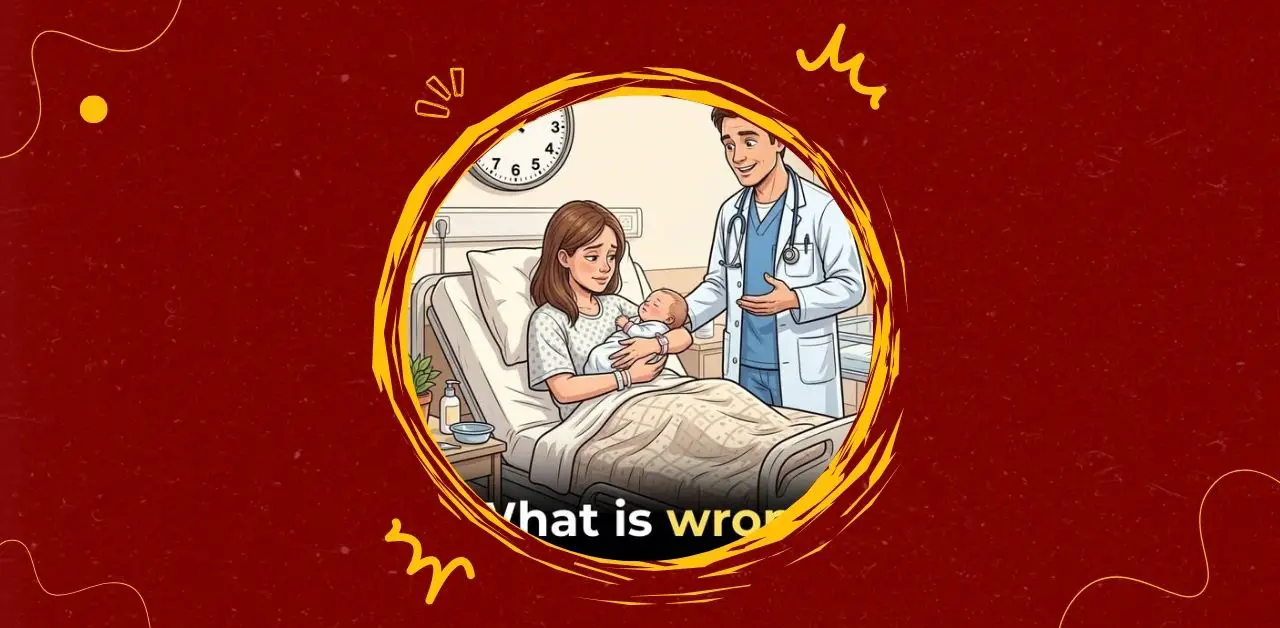
Illustrations are often used in educational materials, puzzles, and visual games to challenge observation skills. A common format is the “What is wrong with this picture?” exercise, where viewers are invited to identify inconsistencies or mistakes hidden within a seemingly ordinary scene. These puzzles sharpen attention to detail, encourage critical thinking, and highlight how easily the human eye can overlook subtle errors.
The Hospital Room Illustration
In the image, a woman is shown sitting up in a hospital bed holding her newborn baby, while a doctor stands beside her smiling. The room is filled with typical hospital details — medical equipment, a bedside table with a plant and cup, and a clock on the wall showing 11:05. At first glance, everything appears normal. However, the caption prompts viewers to look closer: “What is wrong with this picture?”
Identifying the Error
The key inconsistency lies in the clock and its shadow. The clock shows the time as 11:05, but the shadow cast by the clock suggests a light source that does not align with the actual time of day. If it were 11:05 AM, the sunlight would typically come from a higher angle, not from the side indicated by the shadow. If it were 11:05 PM, artificial lighting would likely cast shadows differently. This mismatch between the time displayed and the direction of the shadow is the deliberate “error” in the illustration.
Why Such Errors Matter
These puzzles are not just playful; they serve important purposes:
- Observation Skills: They train the brain to notice details that are often ignored.
- Critical Thinking: They encourage questioning of what seems obvious.
- Educational Value: Used in classrooms, they help students practice logic and reasoning.
- Entertainment: They provide a fun challenge for both children and adults.
Broader Lessons from Visual Puzzles
Beyond the specific hospital room example, “spot the error” illustrations remind us of broader truths:
- Perception vs. Reality: What we see at first glance may not always be accurate.
- Attention to Context: Details like shadows, reflections, or proportions can reveal hidden inconsistencies.
- Everyday Awareness: Training the eye through such puzzles can improve real-world observation, from reading maps to noticing safety hazards.
Conclusion
The hospital room illustration cleverly hides its error in the relationship between the clock’s time and its shadow. This subtle inconsistency challenges viewers to look beyond the obvious and question what they see. Exercises like these are more than games — they are tools for sharpening perception, enhancing critical thinking, and reminding us that details matter. In a world full of visual information, the ability to spot what’s “wrong with the picture” is a skill worth cultivating.